chubby yellow succulent Shop 'Jelly Bean Succulent - Sedum rubrotinctum' Care and Growing Guide
SKU: 95440541809
chubby yellow succulent

chubby yellow succulent Shop 'Jelly Bean Succulent - Sedum rubrotinctum' Care and Growing Guide

Sale price$22.30 Regular price$24.78
Save 10%

Pay in installments of $6.20 with ShopPay, AfterPay and Klarna

Shipping Estimate
USA
  • USA
  • CAN

Ships within 48 hours · Estimated delivery Jul 2 - Jul 7

Promo Codes Available:

For Your Every Summer RSVP, with Code: SUMMER15

Description

chubby yellow succulent Shop 'Jelly Bean Succulent - Sedum rubrotinctum' Care and Growing GuideIntroducing the Jelly Bean Plant, botanically known as Sedum rubrotinctum, is a charming, low growing succulent admired for its colorful, bead like foliage. Its cascading stems make it an excellent choice for hanging baskets, window boxes, and container arrangements, where its colorful foliage can spill over the edges beautifully. Native to Mexico, this evergreen perennial is commonly called pork and beans or banana cactus due to its plump, jelly bean

Introducing the Jelly Bean Plant, botanically known as Sedum rubrotinctum, is a charming, low-growing succulent admired for its colorful, bead-like foliage. Its cascading stems make it an excellent choice for hanging baskets, window boxes, and container arrangements, where its colorful foliage can spill over the edges beautifully.

Native to Mexico, this evergreen perennial is commonly called pork and beans or banana cactus due to its plump, jelly bean-shaped leaves that give it a playful and unique appearance.

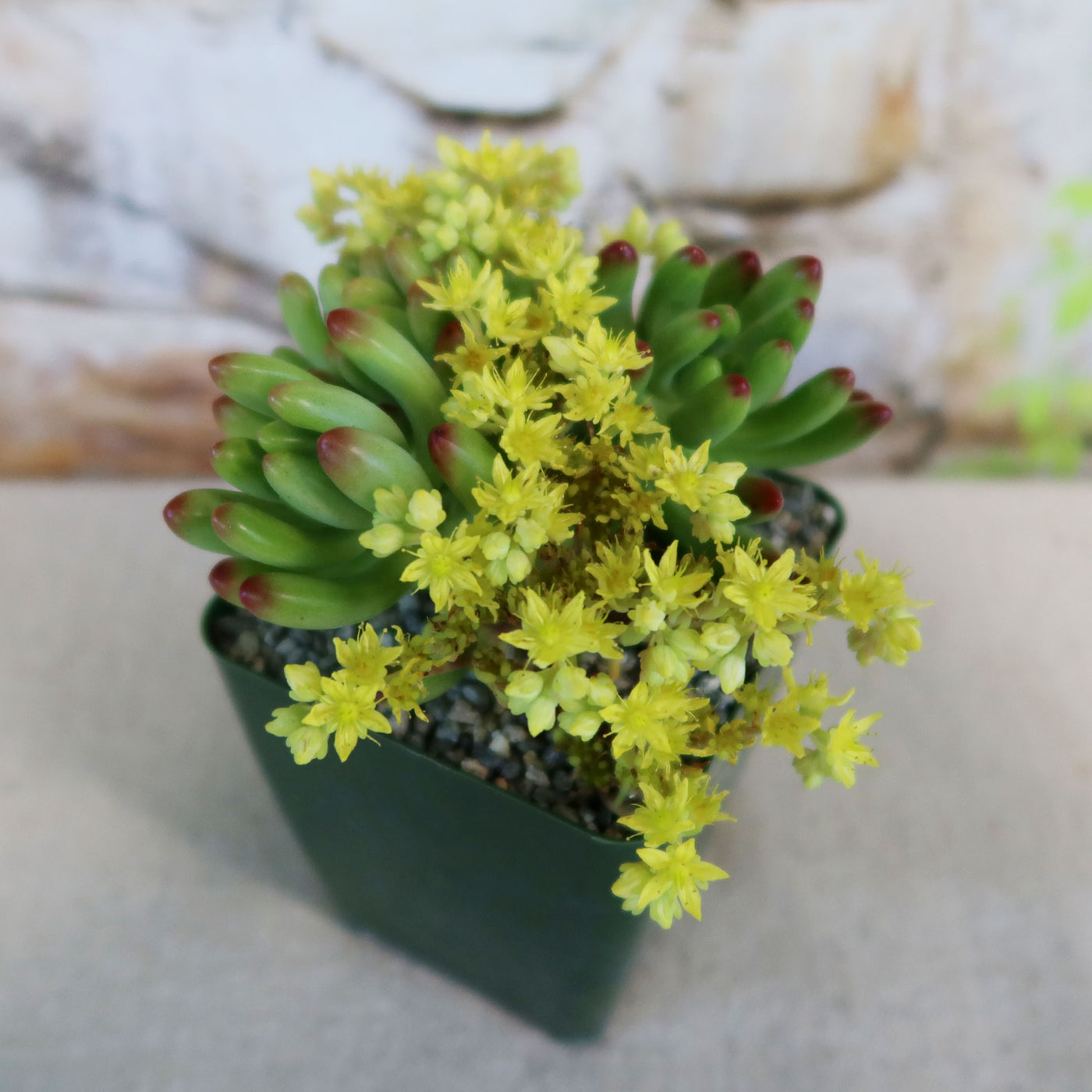
This hybrid jelly bean succulent has small, fleshy leaves that start out green but develop vibrant shades of red, orange, or bronze when exposed to bright sunlight, making it a standout in any succulent collection.

It is often used as a ground cover in rock gardens or featured in decorative containers and dish gardens.

As the plant matures, Sedum rubrotinctum typically reaches about 8 inches tall and up to 24 inches wide, forming a spreading, trailing habit.

Jelly bean succulent flowers are yellow, small, and star-shaped, blooming in clusters at the tips of their stems.

While the blooms are subtle, they provide a delicate contrast to the bold foliage and usually appear in spring to early summer.

Related Product

What truly makes the jelly bean succulent so popular is its combination of low-maintenance care and vibrant color transformation. It is drought-tolerant, easy to grow, and adapts well to both indoor and outdoor environments with proper light. Its ability to change color with sunlight adds dynamic beauty throughout the year.

When and How to Water Your Sedum rubrotinctum Plant

This jelly bean succulent is highly drought-tolerant and prefers drying out between waterings, making it more resilient to underwatering than overwatering.

The Sedum rubrotinctum should be watered once every 1-2 weeks during the growing season, with light soaking and minimal watering once every 3-4 weeks during the dormant season, with very light moisture.

During the active growing season, allow the soil to dry out completely between waterings. This helps prevent overwatering, which can cause the Sedum rubrotinctum roots to rot.

During the dormant season, your jelly bean requires even less water. It's important to remember that succulents like the jelly bean plant are more tolerant of underwatering than overwatering.

Light Requirements - Where to Place Your Jelly Bean Succulent

When growing indoors, you can grow it in the areas where it can receive atleast at least 6 hours of bright, direct light to maintain their vibrant red coloring and compact, healthy growth. 

Place it near a window that receives plenty of sunlight, but make sure to protect your jelly bean plants from direct exposure to intense sunlight, especially during the hottest parts of the day.

A south or west facing window works best, but protect it from harsh midday sun. If natural light is limited, you can use grow lights. 

When growing outdoors, it loves basking in the full sun, so find a location in your garden or patio that receives at least 6 hours of direct sunlight each day. 

When grown in direct sunlight, the color ranges from bright green leaves to red-tipped leaves, with the brightest hues.  However, it's important to note that the jelly bean plant can also tolerate partially shaded areas, especially in regions with intense summer heat. 

Newly purchased jelly bean succulent may burn if placed in full sun right away, so increase exposure gradually.

  1. If the leaves stretch or turn pale, it needs more light.
  2. If they become scorched or develop brown spots, it is getting too much sun.

Optimal Soil & Fertilizer Needs 

The Sedum rubrotinctum favors very airy, sandy soil that drains well, and NPK fertilizers once a year in spring. Planting your Sedum rubrotinctum in ordinary wet soil will result in compacted roots, stunted growth, and, most likely, root rot. Instead, make or buy a well-draining potting mix, or ideally, use our Go to Soil cactus mix blend 1 gal 4 qt cacti succulent dirt compost growing media that contains organic mycorrhizae to promote the development of a strong root system that helps your jelly bean plants and other succulents to thrive. 

A balanced, low-strength fertilizer works best for your Jelly bean succulent plant, ideally with an NPK ratio around 5-10-5, where phosphorus is slightly higher than nitrogen to support healthy growth. Apply fertilizer once in spring at the start of the growing season to give it a gentle boost to support stronger roots and better nutrient absorption. 

Hardiness Zones & More 

In the United States, this jelly bean succulent is mostly an indoor plant, but if you live in southern Florida or Hawaii, then you can cultivate it outdoors in USDA zones 9-11.

If you live in a colder climate, it's best to bring the jelly bean plant indoors or provide some protection during the winter months.

As for humidity, the jelly bean plant can handle a range of humidity levels, from drier to more humid environments. Just ensure that the soil has good drainage to prevent waterlogged conditions. 

How to Grow as a Houseplant 

Your jelly bean succulent grows best indoors in temperatures between 60°F and 75°F. It can tolerate slightly cooler temperatures during the winter months, but it's best to keep it away from drafts or extreme temperature fluctuations. As for humidity, the Sedum rubrotinctum jelly bean plant can handle average indoor humidity levels, so you don't need to worry too much about providing extra humidity. Just make sure the air isn't too dry, especially during the winter when indoor heating can cause dryness. 

Wildlife - Jelly Bean Succulent Flowers Attract the Following Friendly Pollinators 

Jelly Bean Succulent 'Sedum rubrotinctum' can attract friendly pollinators such as bees, butterflies, hummingbirds, and other beneficial insects. These pollinators play a crucial role in the ecosystem by aiding in the reproduction of plants and ensuring biodiversity.

Butterflies
Bees
Hummingbirds
Lady Bugs
Multi Pollinators
Other Birds

According to ASPCA, the Sedum rubrotinctum is mildly toxic to humans or pets if ingested in large amounts. However, it is safe to touch and handle, making it a popular choice for indoor gardens or landscaping due to its vibrant colors and low maintenance requirements.

How to Propagate Your Sedum rubrotinctum Plant 

To propagate your jelly bean plants, stem or leaf cuttings can be used. Both are simple and have a high success rate. Keep the cutting in a spot with bright, indirect light instead of direct sunlight, and give it some time until you begin to see new growth. 

Key Takeaways

  1. Jelly bean succulents are low-maintenance and drought-tolerant. They prefer infrequent watering and can handle dry conditions better than excess moisture, making them beginner-friendly plants.
  2. 'Sedum rubrotinctum' is known as pork and beans succulent or banana cactus, because of their jelly bean-shaped leaves.
  3. These succulents thrive in airy, sandy soil, and keeping roots from sitting in moisture is key to maintaining plant health.
  4. Jelly bean succulents' leaves shift from green to vibrant red or bronze, in bright sunlight.

Final Thoughts

Overall, the jelly bean succulents (Sedum rubrotinctumm) are captivating succulents with their bean-shaped leaves and trailing growth habit. With their vibrant green foliage and occasional bursts of colorful flowers, they add a touch of whimsy to any space. A succulent tends to live for many years and grows slowly. Plant them in the spring after the weather warms up. Propagating these succulents is relatively easy, whether through stem cuttings or fallen leaves. Jelly bean succulents are a delightful addition to any succulent collection, bringing charm and beauty to both indoor and outdoor settings. If you're looking for a unique and low-maintenance plant, the jelly bean succulent is definitely worth considering!

Don't miss out on this opportunity to add something truly exceptional to your garden. Order your very own jelly bean Sedum rubrotinctum today!
Shipping Notes
  • Free Standard Shipping on $100+ Orders to the USA.
  • Except Preorder products are shipped in 48 hours.
  • Delivery to the USA:
  1. Standard Shipping : 3-10 business days
  • If time is of the essence, please consider selecting expedited delivery for faster service.
Exchange/Return Notes
  • We offer a 30-day return/exchange service after receiving.
  • Final sale items are not eligible for returns or exchanges.
  • To process your return/exchange, please contact us at [email protected]
  • Please click here for more details>>> Return & Exchange Policy
SKU: 95440541809

Discover Niche Categories That Outsell chubby yellow succulent

Top-Converting Item to Boost Your Average Order

4.8 ★★★★★
Based on 294 reviews
Sort
Highest Rating
Newest First
Oldest First
Product Reviews
B
Verified Purchase
bdb.seb
Draper, US
★★★★★ 4
Lovely
Format: Paperback
"Because God does not change and his kindness does not end, though the mountains shift and whole worlds crumble, and to actually believe this means to live a different kind of life from one tossed and overturned by news of every new disaster." Love the Clarkson family's books and stories. Such a wonderful way with words. I disagree with some of the theology but still consider this a good read.
WAS THIS REVIEW HELPFUL?YesReportShare
Reviewed in the United States on December 4, 2024
D
Verified Purchase
Debilea
Carnegie, US
★★★★★ 5
Attending to the inmost places of our heart
Format: Paperback
Sarah Clarkson’s newest book, “Reclaiming Quiet” is a masterful journey into the heart of what it means to be quiet before the Lord. I was hooked by the foreword and by the end of the first chapter, I was thinking of numerous friends I wanted to share this book with. We live in a noisy, attention-distracting world and it’s far too easy to get sucked into one activity after another without one thought of being still, of finding the rest and restoration that our mind, body and soul crave. Sarah’s writing draws the reader in with the loveliest of vignettes from her life as a Vicar’s wife, mother of 4 and author. Her writing is lyrically gorgeous-each story comes alive by her excellent word choice and vivid descriptions. She shares her struggles with OCD and really gets to the heart of what it means to find quiet in the midst of the busyness of each day. This is not a how-to or another step-by -step book, but more of a path that will guide the reader into thoughtful pondering of what it means to be still -to make time to sit quietly and commune with our Creator. A favorite quote from her book: “One of the great gifts that comes to us when we choose to step away from the chorus and listen to the Holy Spirit, is a capacity for conviction and courage. We need to attend in the inmost places of our hearts, where God speaks…We need to listen from the inside.” Reclaiming Quiet would make an excellent book club selection for a small group or to explore on your own-you won’t be disappointed. I can see this becoming a bestseller.
WAS THIS REVIEW HELPFUL?YesReportShare
Reviewed in the United States on November 5, 2024
P
Verified Purchase
Paul
Dallas, US
★★★★★ 5
American Bullies at Bretton Woods
Format: Hardcover
There, I said it, and I am an American. I had heard of the conference but never read about it, and certainly had never heard of Harry Dexter White, but this book goes to great length to explain what happened in this important meeting as World War II was drawing to a close and a plan needed to be developed for a new world order regarding the flows of money to facilitate trade and avoid economic disruptions that the world had seen far too much of. Steil presents more information on John Maynard Keynes than his American antithesis, Harry Dexter White, and for good reason. Keynes was simply one of the most, if not the most, brilliant intellectuals of the 20th century. His theories of economics were evolving through his life, but he is most remembered for his idea that government stimulus could help alleviate a faltering economy when the private sector failed to do the job, and he was opposed as he said to the "gold cage" that for years had been the standard of international finance. He had a biting wit, coupled with a superior intelligence that far outshone his meager appearance (he was ugly, and knew it) but he was cast in the role of a diplomat to present the case for England as the world entered the post war period. The problem was that England was broke. She had endured two world wars in the space of 30 years and the empire was begging for funds from Washington, and most of her debt to the US from the Great War was still unpaid. She also had an enemy in FDR, who was determined that the imperial preference of England after the war was to be no more. Her crown jewel, India, was pressing for independence and the empire was in the process of unwinding, as was the strength of the British sterling. Keynes pressed to have the new institutions of the World Bank and the IMF located in London, and the Americans under the leadership of White simply said "hell no." Enter Harry Dexter White. The name is as deceptive as the individual. He was a son of Jewish immigrants, graduating from Harvard late in life, but brilliant in his intellect and determined that America would rule by the strenght of the dollar and Britain was to be no more as a world power. It was interesting to me to see the Treasury Department so powerful over this whole thing. You may think that the Department of State would have more of an influence because these were important global decisions, but their input was minimal. Regardless, White was a Soviet sympathizer and was just in the process of getting raked over the coals when he died early after the war from a heart attack. Keynes also died at the age of 62, not long after the war. The world remember Keynes and White is more of a footnote. I personally did not like White. He reminded me of a Himmler with his rim glasses and nasty litte mustache. As for his boss, Henry Morganthau, Secretary of Treasury, he was little better. His idiotic plan to strip Germany of all industrial capability after the war and turn it into a nation of small farms was leaked to the press and Goebbels made hay of it, likely resulting in many more American casualities toward the end of the war. Just goes to show that FDR used some strange people in his administration. Thank God his selection of generals was far better. America was brutal toward the British at Bretton Woods. We often think of the English speaking peoples uniting and working together in true harmony to defeat the fascist nations. That is a myth and this book helps bust it. It shows to me how inhuman America was to our British allies, who bore much of the battle of this war alone, with little hope of survival. It is said that when Winston Churchill learned of the attack on Pearl Harbor, he knew that England would win the war and when he retired, he slept like a baby. Little did he know that the selfishness of the U.S. government would put a boot on the neck of England after the war. Churchill once said that the Germans were either at your throat or under your foot. The later part of that pertains to the American response to England toward the end of the war and after. A good book. Great information, and highly recommended.
WAS THIS REVIEW HELPFUL?YesReportShare
Reviewed in the United States on March 9, 2013
A
Verified Purchase
Andrew A.
Bozeman, US
★★★★★ 4
Easy read on Difficult subject
Format: Kindle
This well-documented book explodes the myth of Bretton Woods. The battle between Harry White and John Maynard Keynes turns out to have been contrived.
WAS THIS REVIEW HELPFUL?YesReportShare
Reviewed in the United States on May 30, 2026
E
Verified Purchase
Eric G
Draper, US
★★★★★ 5
A great book for anyone interested in US foreign policy, history, or economics
Format: Hardcover
In July of 1944 representatives from forty-four nations gathered at the Mount Washington Hotel in Bretton Woods, NH to establish the rules for the post World War II international monetary system. Although nations from around the globe were at the table, the primary debate was between the United States and Great Britain. The U.S. was determined to advance a policy ensuring the dollar reigned supreme in world trade, thus guaranteeing American dominance. The British were holding out for a monetary system that would not relegate them to a secondary status after the war. Representing the two great nations were two men. For the U.S. it was a little-known economist working as an assistant to the Secretary of Treasury, Harry Dexter White, and representing the British was world-known economist John Maynard Keynes. Benn Steil examines the Bretton Woods conference, and the inter-war years leading up to it, using these two men as a backdrop. Not only is the work well researched, but as a senior fellow and director of international economics at the Council on Foreign Relations, Steil is eminently qualified to make economic judgements. Steil’s thoroughness and expertise combine to make an enjoyable read of what could otherwise be an exceptionally dry topic. The main argument Steil makes is that the dominance of dollar in the post WWII economy was a fait accompli at Bretton Woods. Mr. Steil introduces the reader to the relatively unknown Harry Dexter White, a minor player at the U.S. Treasury commanding great influence. Steil shows the reader that going into Bretton Woods, White and his boss, Treasury Secretary Henry Morgenthau, were committed to bringing President Roosevelt’s New Deal to the rest of the world. Part of this plan was to shift power not only from London, but from Wall Street as well, to the U.S. Treasury. White was convinced international banking had played a key role in creating the instability responsible for WWII. A new gold standard tied to the U.S. dollar would ensure stability in White’s view. Ultimately White’s ideas led to the creation of “the three so-called Bretton Woods institutions: the International Monetary Fund (IMF), the World Trade Organization (WTO), and the World Bank” (Steil, The Battle of Bretton Woods, 127). Adding intrigue to economics Steil also shows through declassified F.B.I. documents and recently discovered writings by White, that White was an agent of the Soviet Union. Keynes is often regarded as “the first-ever international celebrity economist” (Steil, The Battle of Bretton Woods, 3). While this may be true, he was no match for the little-known White. White (and Morgenthau) considered the British a threat on the economic stage and made sure their Lend-Lease terms would bankrupt the U.K. by the end of the war and bring them to the bargaining table. As well as being an interesting historical read, and a useful primer on international monetary policy, Steil captures the importance of economic policy in relation to foreign policy. Morgenthau and White realized the power of the U.S. to inflict its will upon other nations was rooted in the power of the dollar. Today as then, U.S. power flows from the economy. Students of modern U.S. foreign policy would be wise to have a basic understanding of U.S. economic policy and how the U.S. economy interacts in the global system.
WAS THIS REVIEW HELPFUL?YesReportShare
Reviewed in the United States on March 2, 2020

recommand products